
Beyond the Iron Fist:
Can the Bundeswehr Restore Maneuver in a Transparent Battlefield?

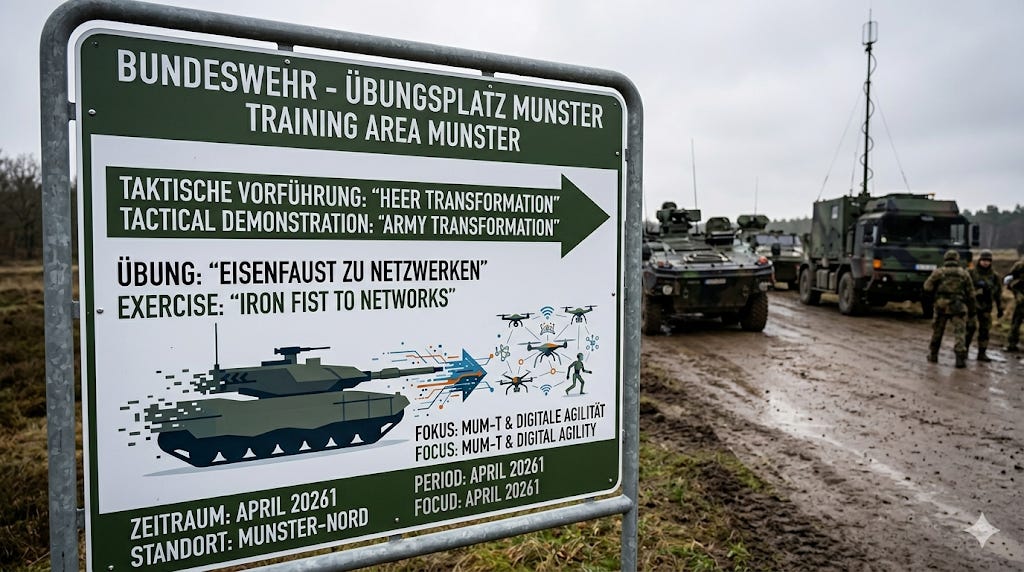
1. Introduction: The Munster Paradigm and the Ghost of Attrition
The tactical demonstration held in Munster in April 20261 was not merely a display of procurement; it was the crystallization of the German Land Forces’ ( Heer ) structural transformation—a funeral for the 20th-century “Iron Fist.” For years, the specter of “attritional stagnation,” a paralysis born of absolute battlefield transparency in Ukraine, has threatened the relevance of NATO’s heavy formations. The Heer’s response is a radical departure from legacy doctrine, aiming to dismantle this “paralysis” through a symbiosis of human-machine teaming (MUM-T). The central thesis is diagnostic: to survive a peer-level conflict by the 2029 readiness deadline, the Bundeswehr must restore high-speed maneuver by redefining combat power entirely. We are witnessing a transition from a force that survives by its thickness of steel to one that survives by its digital agility. Strategic Imperative: From “Physical Mass” to “Mass of Effects” The era of concentrating “hulls per square kilometer” is over; it is a recipe for kinetic elimination. Success now demands a shift to the Mass of Effects, where density is measured in “lethal effects per unit of time” rather than physical presence. In the 21st century, mass occurs in time, not in space. This evolution is necessitated by a grim reality: the traditional armored concentration has transitioned from a center of power to a “vulnerability center.”
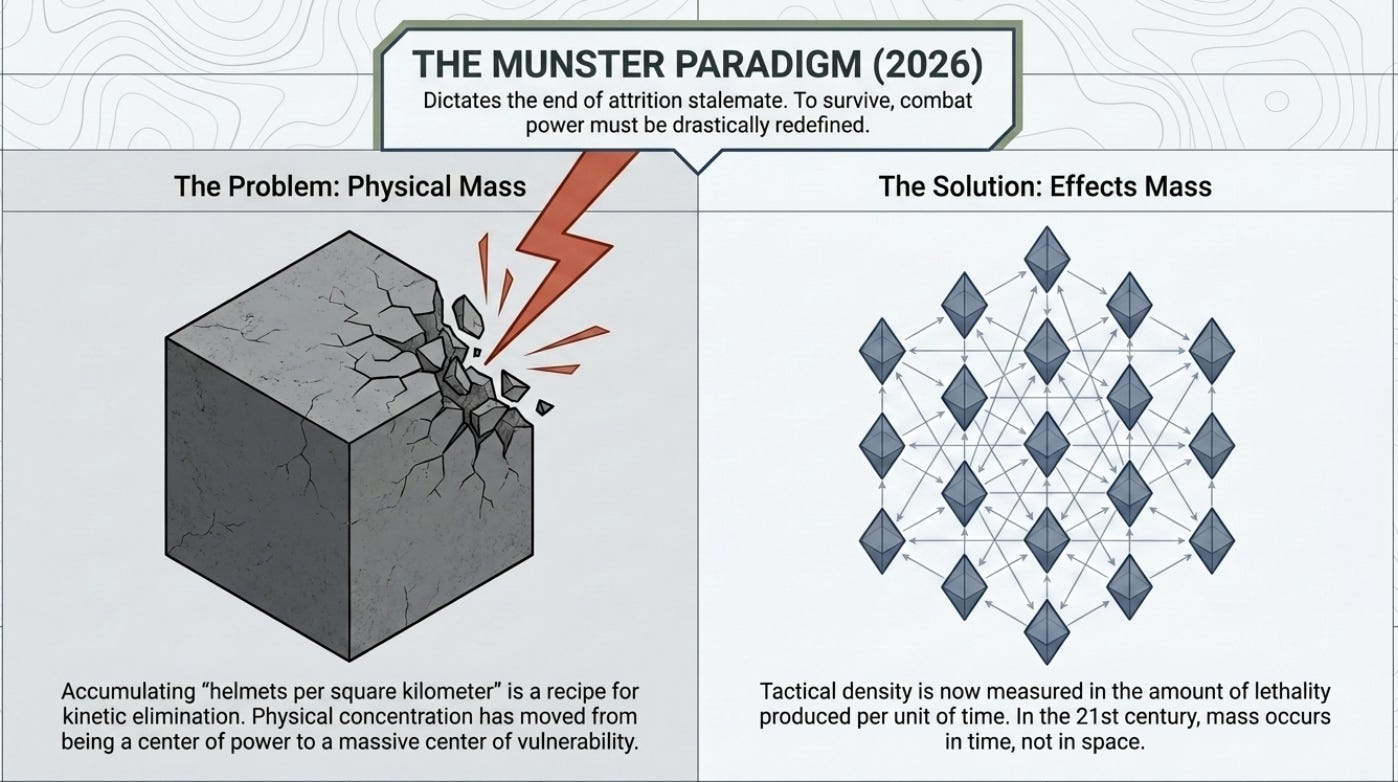
2. The Anatomy of Tactical Failure: Why “Physical Mass” is Now a Death Sentence
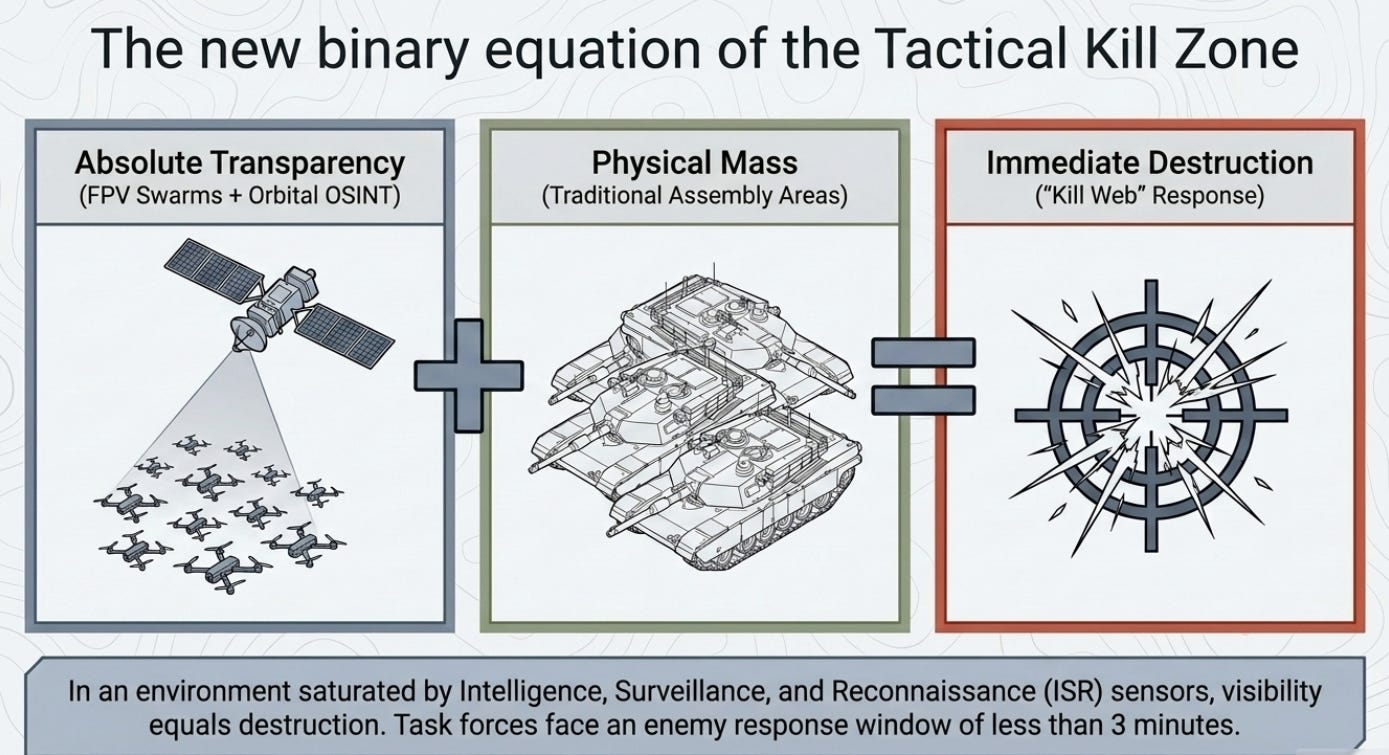
In an Intelligence, Surveillance, and Reconnaissance (ISR) environment defined by orbital OSINT and pervasive FPV swarms, the traditional assembly area is a magnet for destruction. The modern battlefield has become a “Death Zone” characterized by omnidirectional lethality. Within this zone, the equation of survival is merciless and binary: Transparency + Physical Mass = Immediate Destruction. If visibility equals destruction, the only solution is to redefine how a force “exists” on the map. To remain concentrated is to invite a “Kill Web” response that, as observed in current peer conflicts, now targets and strikes within a window of less than three minutes.
The Geometry of Lethality
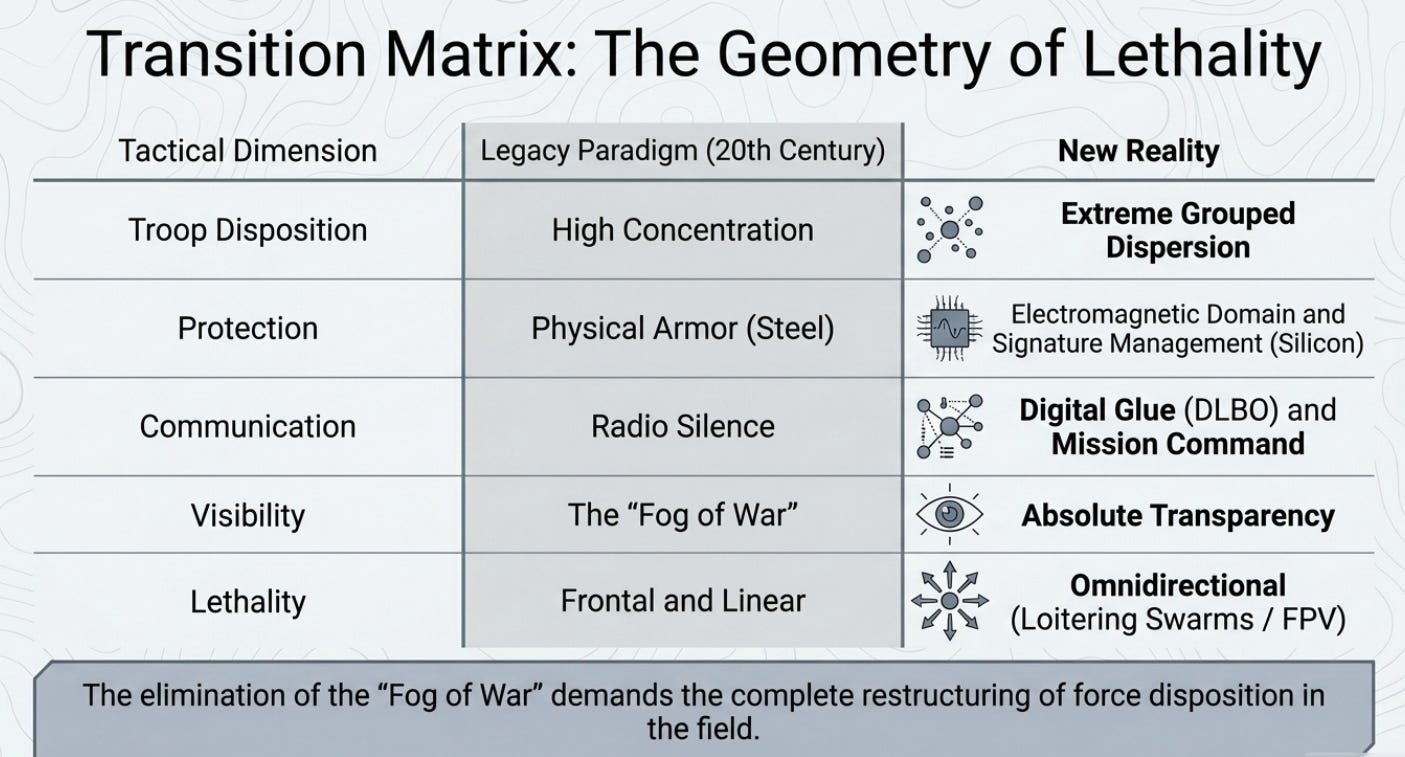
3. The New German Architecture: A Four-Zone Deep Exploration
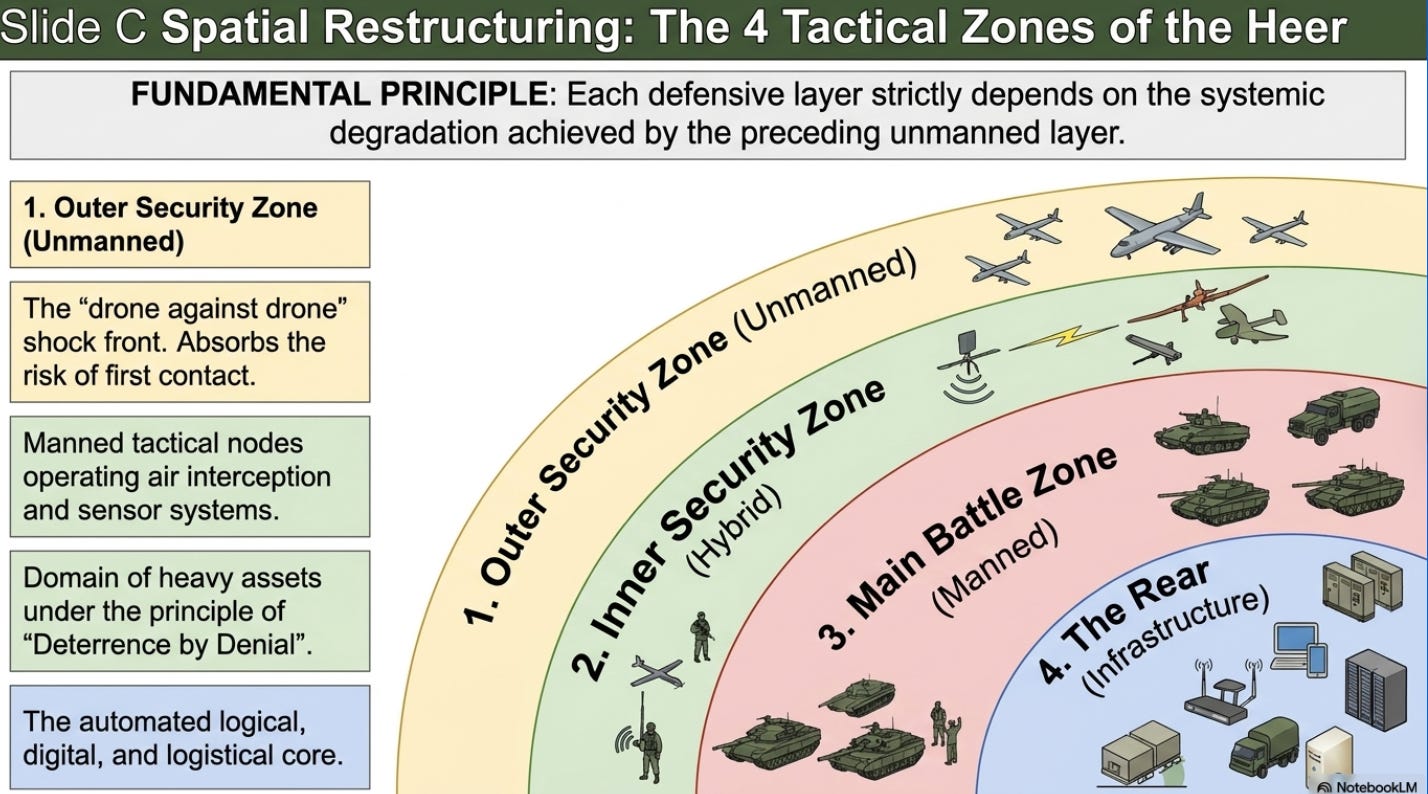
To mitigate the risks of this transparent environment, the Heer has reorganized its battle space into four zones. Each layer is strictly dependent on the degradation achieved by the preceding unmanned layer.
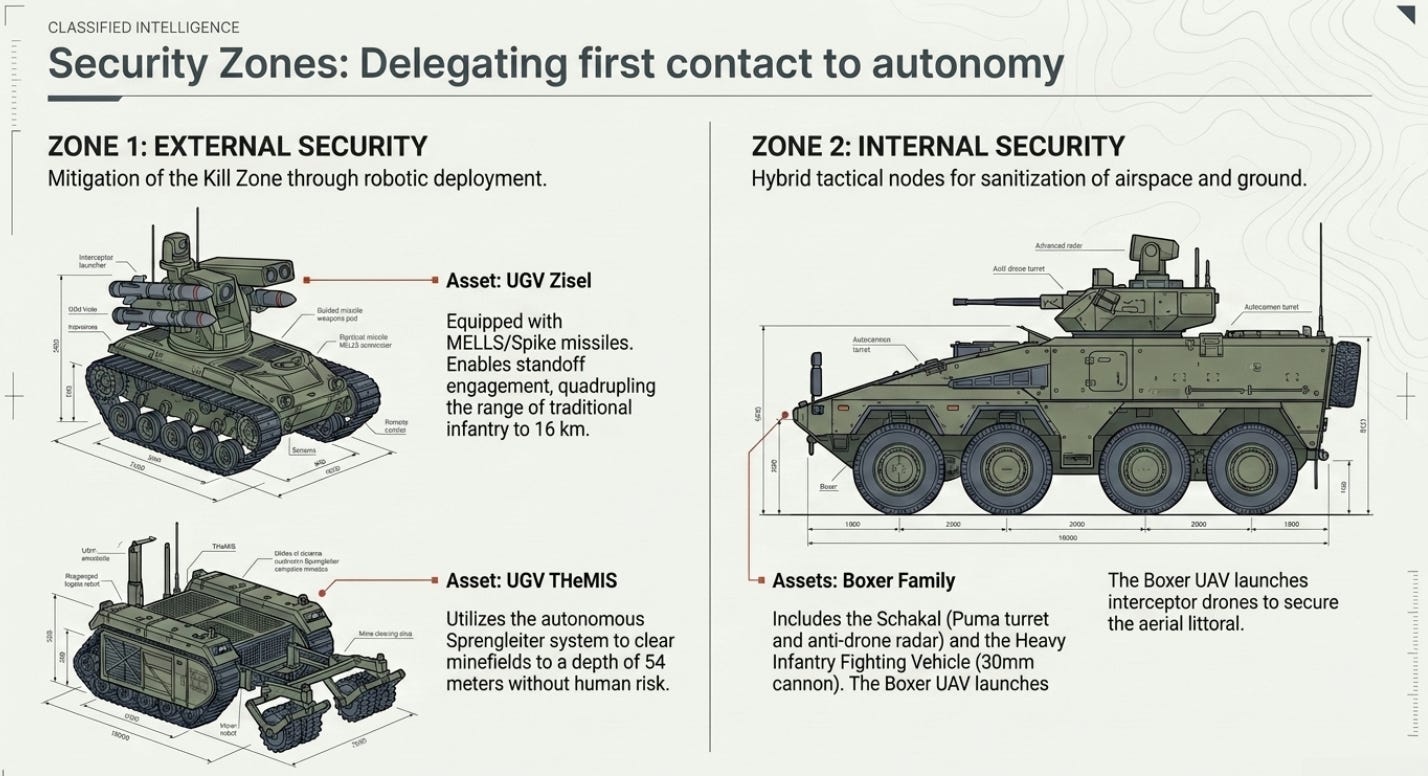
Unmanned Outer Security Zone: The “drone against drone” frontier. Here, the Zisel UGV, armed with MELLS/Spike missiles, enables Abstandsfähig (stand-off) engagement, quadrupling traditional infantry ranges to 16km. Simultaneously, the THeMIS UGV utilizes the Sprengleiter (explosive ladder) to autonomously clear minefields to a depth of 54 meters, absorbing the “first contact” risks of the Death Zone.
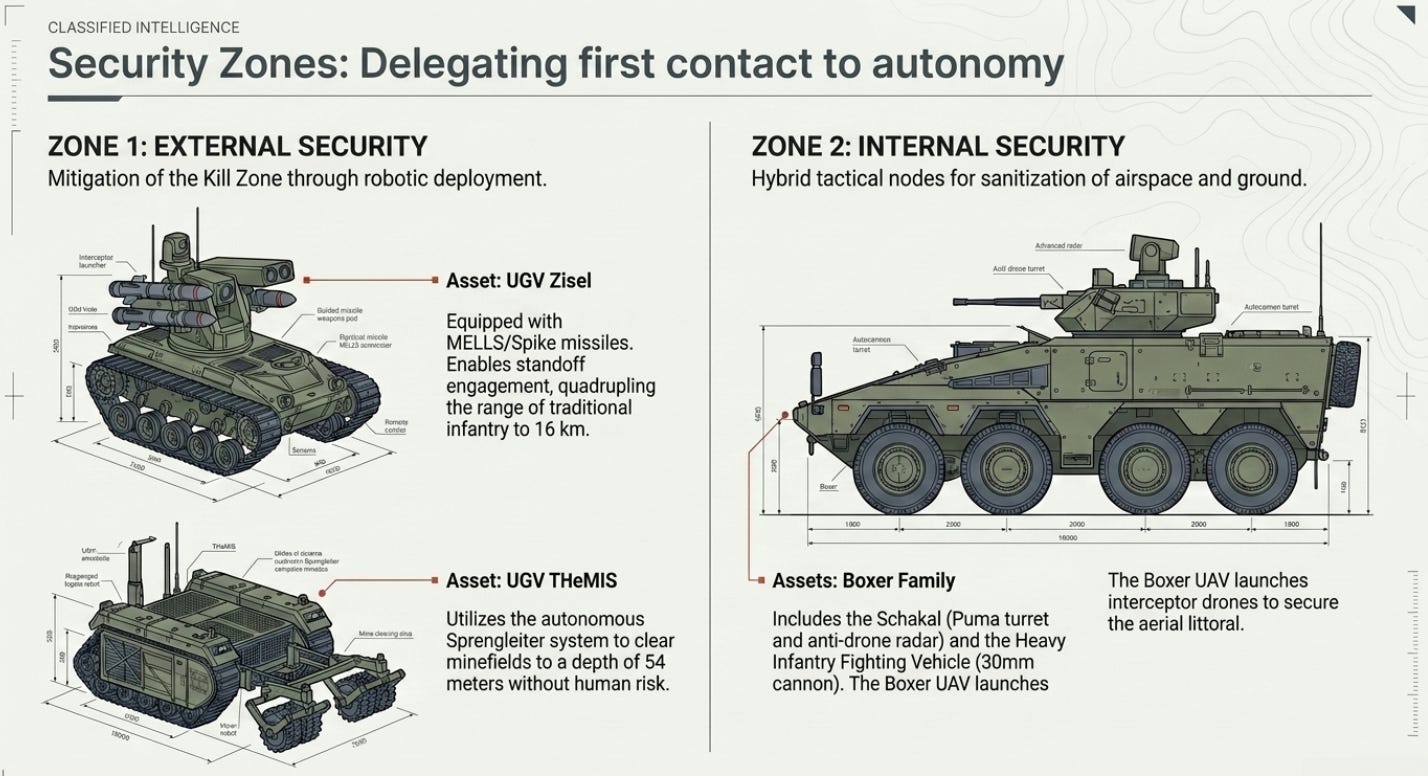
Manned Inner Security Zone: This zone features the Boxer armored personnel carrier variants. Crucially, this includes the Schakal (a Boxer equipped with a Puma turret and drone-detection radar) and the Schwerer Waffenträger Infanterie (Heavy Weapons Carrier) with its 30mm cannon. The “Boxer UAV” variant acts as a tactical node, launching interceptor drones to sanitize the Air Littoral.
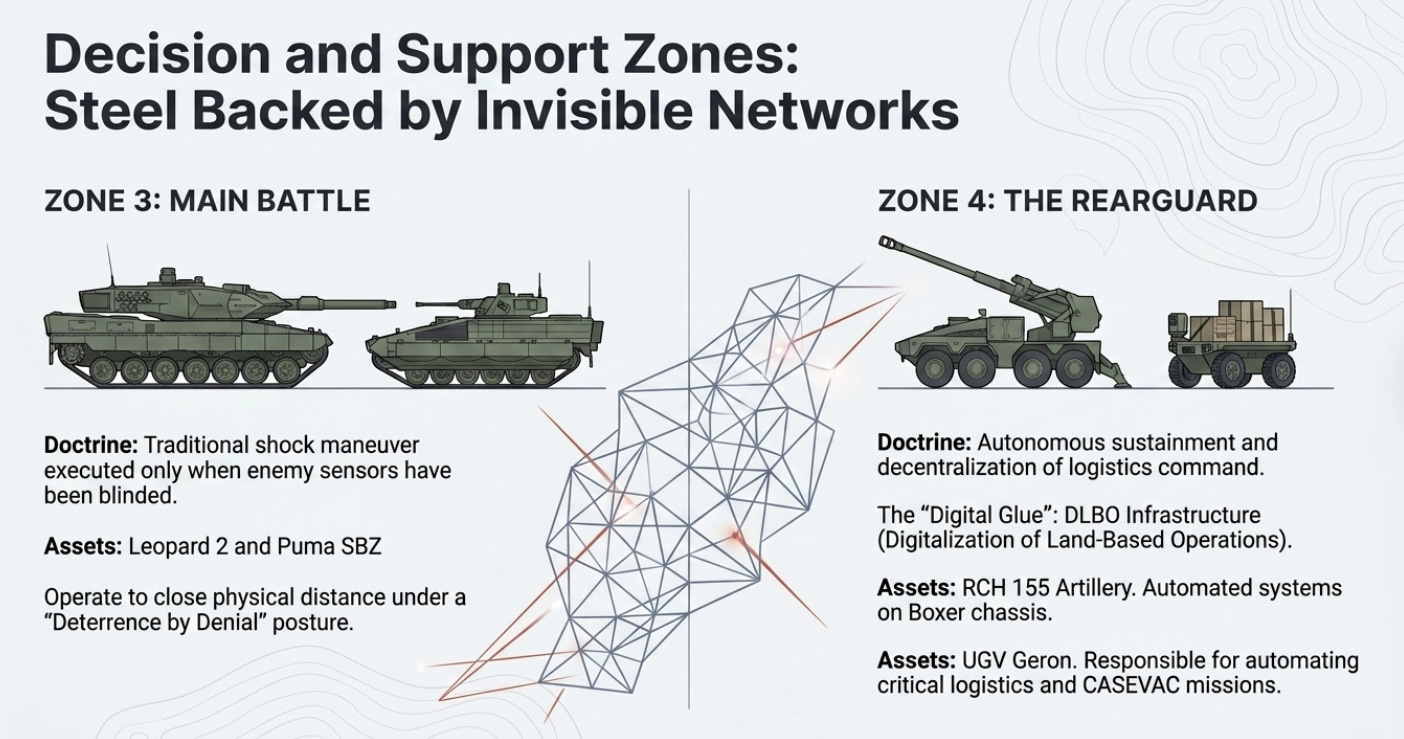
Main Battle Zone: The domain of the Leopard 2 and the Puma SBZ (Infantry Fighting Vehicle). Operating under “Deterrence by Denial,” these heavy assets close the distance to destroy the enemy through shock action—but only after the security zones have “blinded” the enemy’s counters.
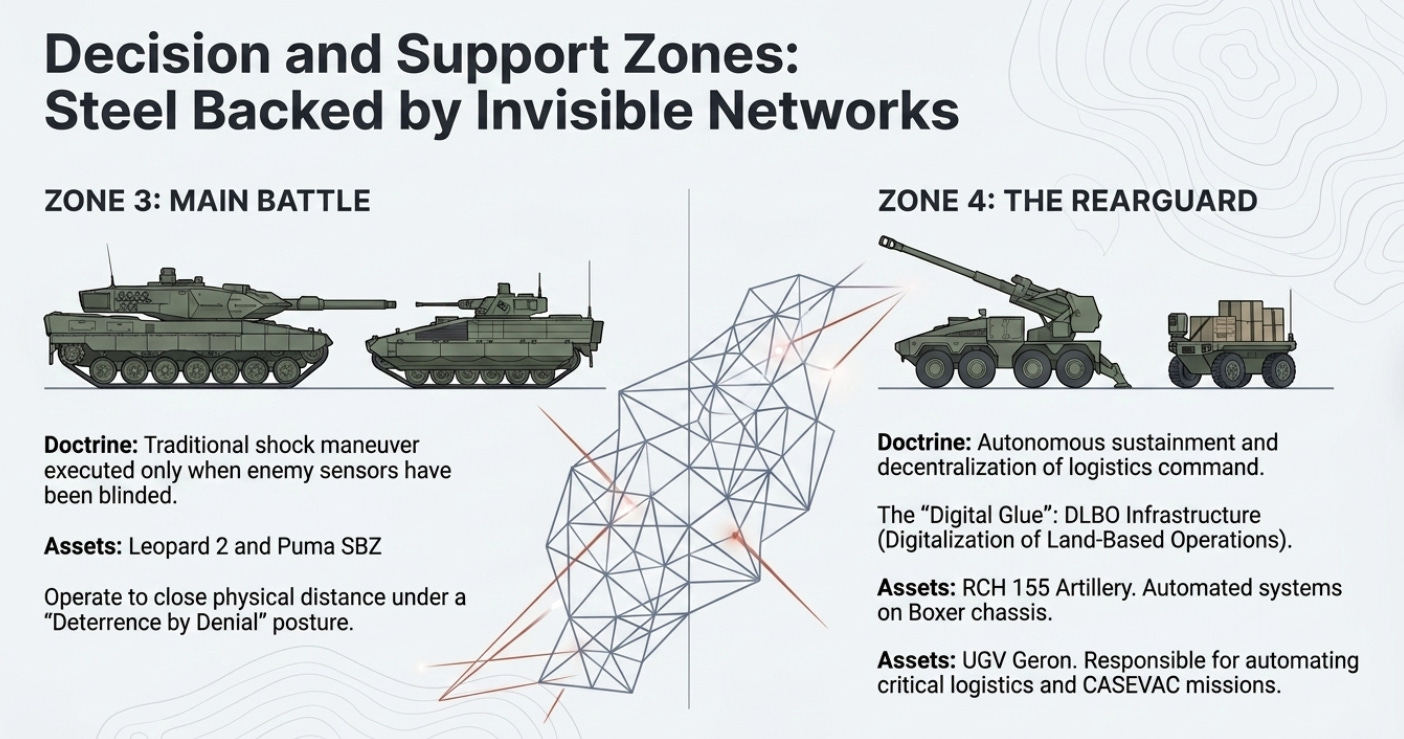
The Rear: The “Digital Glue” housing the DLBO (Digitalization of Land-Based Operations) infrastructure. This zone features the RCH 155 (automated artillery on Boxer chassis) and the Geron UGV, which automates the “Ant Flow” of logistics and CASEVAC missions.
4. Controlling the “Air Littoral”: The Prerequisite for Movement
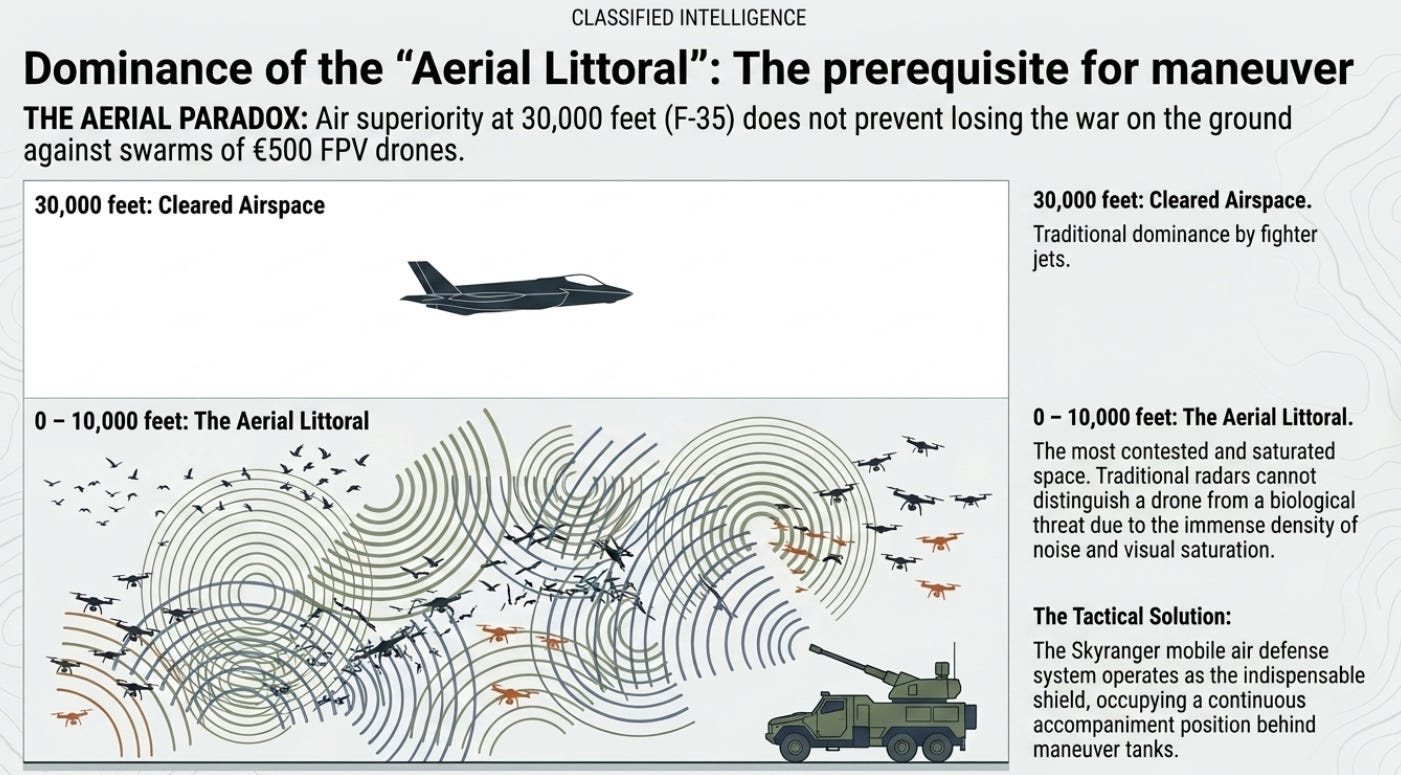
The “Air Littoral” (0–10,000 ft) is the “shallow water” of the sky—the most contested frontier of modern warfare. It is a space filled with “clutter” (noise) where traditional radars struggle to distinguish a Mavic drone from a migrating goose. The paradox of modern air superiority is that you can own the sky at 30,000 feet with F-35s and still lose the war at 500 feet to a €500 FPV drone. The Skyranger mobile air defense system is the “indispensable shield” here, occupying a Begleiteinsatzstellung (accompanying position) immediately behind maneuvering tanks.
Soft-Kill vs. Hard-Kill Strategies
The Bundeswehr employs a layered defense against the Air Littoral’s saturation:
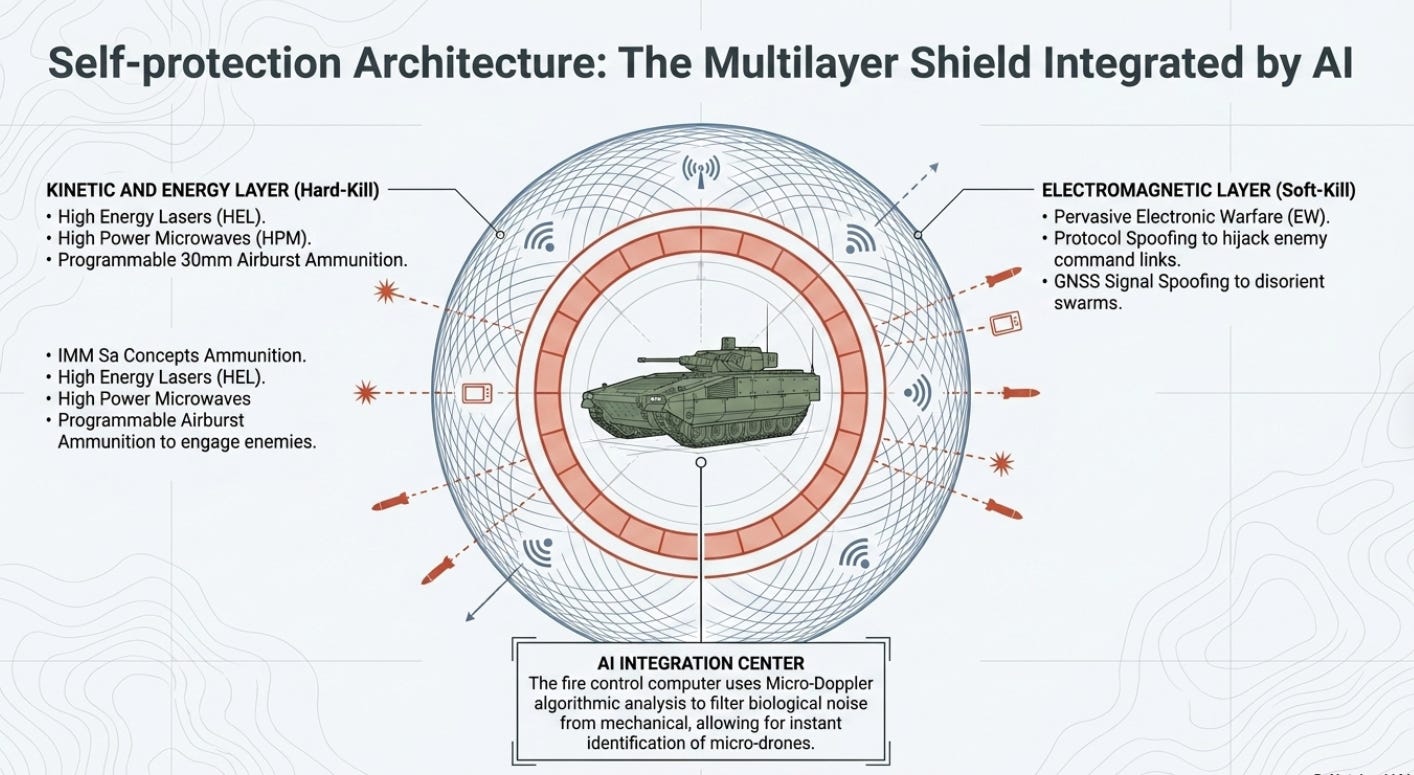
Soft-Kill: EW jamming, protocol spoofing to hijack command links, and GNSS spoofing.
Hard-Kill: High-Energy Lasers (HEL), High-Power Microwaves (HPM), and kinetic solutions.
AI Integration: The Puma’s fire control computer now utilizes Micro-Doppler analysis to distinguish drones from biological clutter, enabling “Platform Autoprotection” with programmable 30mm airburst ammunition.
5. Tactical Geometry: The Doctrine of “Grouped Dispersion.”
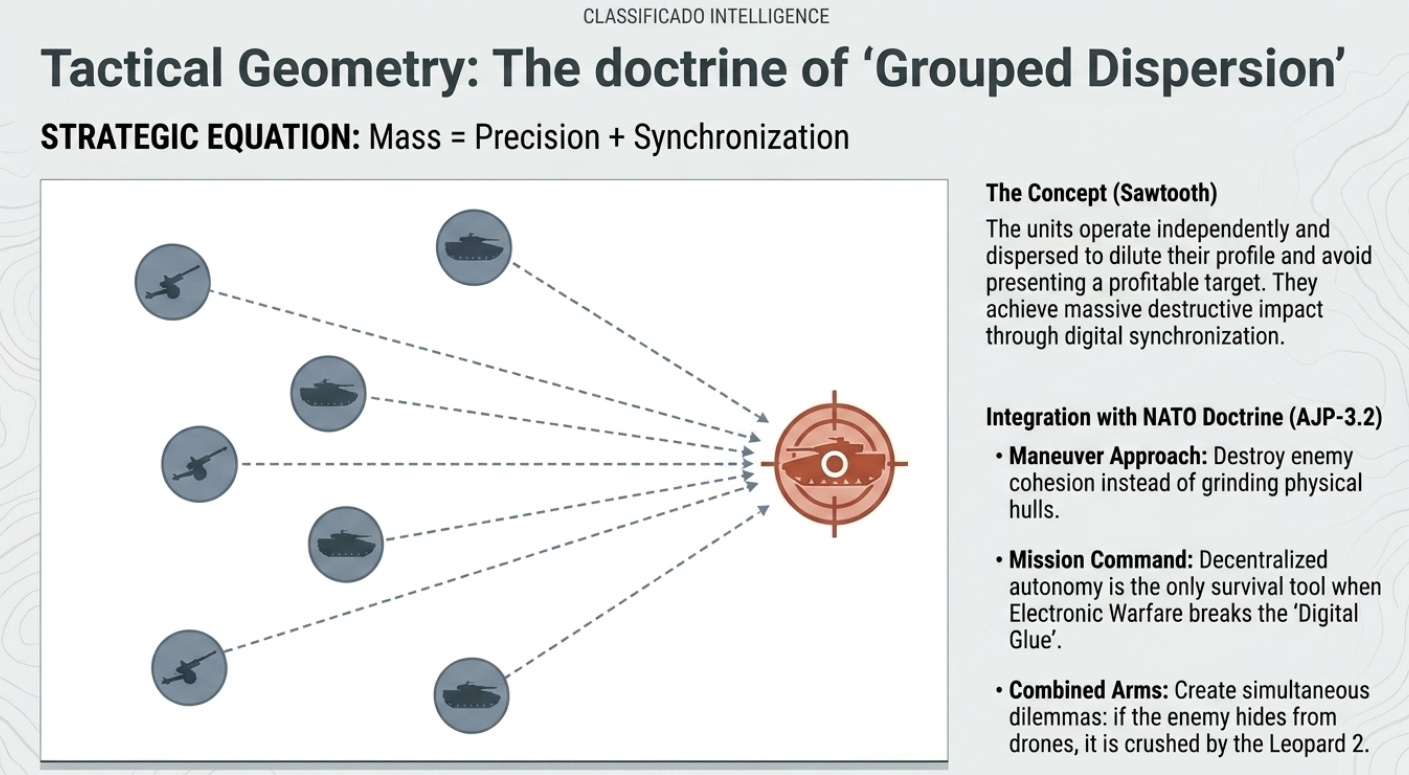
The strategic imperative of the “Mass of Effects” is defined by the equation: Mass = Precision + Synchronization. To avoid presenting a “rentable” target, units operate via Grouped Dispersion —physically separated to survive, but digitally synchronized to strike.
The Survival Cycle
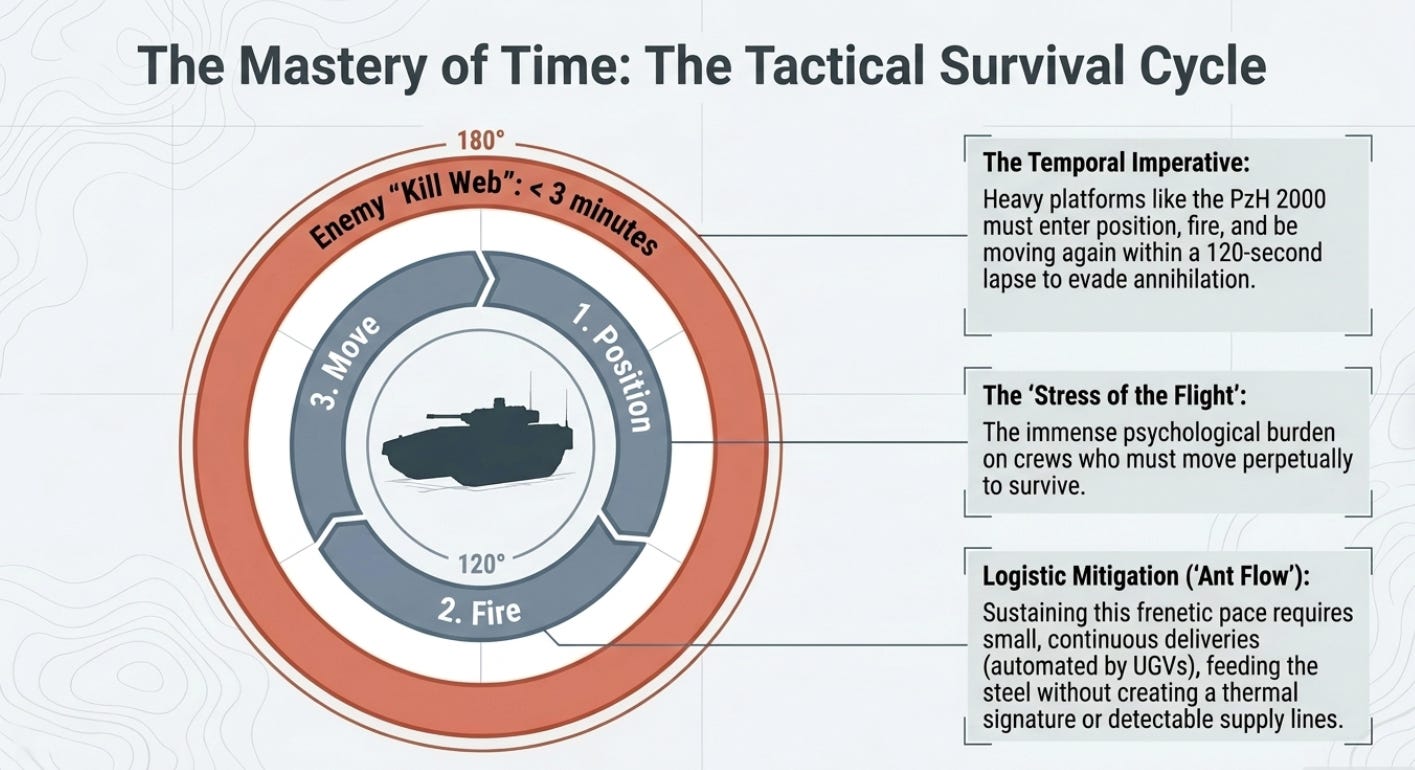
The 2-Minute Survival Cycle: To survive counter-battery fire, systems like the PzH 2000 must enter position, fire, and be in motion again within 30 to 120 seconds.
Kill Web Timings: The current standard requires the time between detection and massed impact to be less than 3 minutes.
Sawtooth Deployment: Artillery pieces operate dispersed and independently, diluting the target profile while achieving synchronized impact through digital networking. This approach integrates the three pillars of NATO AJP-3.2 Doctrine :
Manoeuvrist Approach: Shattering enemy cohesion rather than grinding through hulls.
Mission Command): Autonomy is the only survival tool when EW degrades the “Digital Glue.”
Combined Arms Integration: Creating simultaneous tactical dilemmas—if they hide from the drones, they are crushed by the Leopard 2.
Conclusion: The Zeitenwende is Not About Hardware
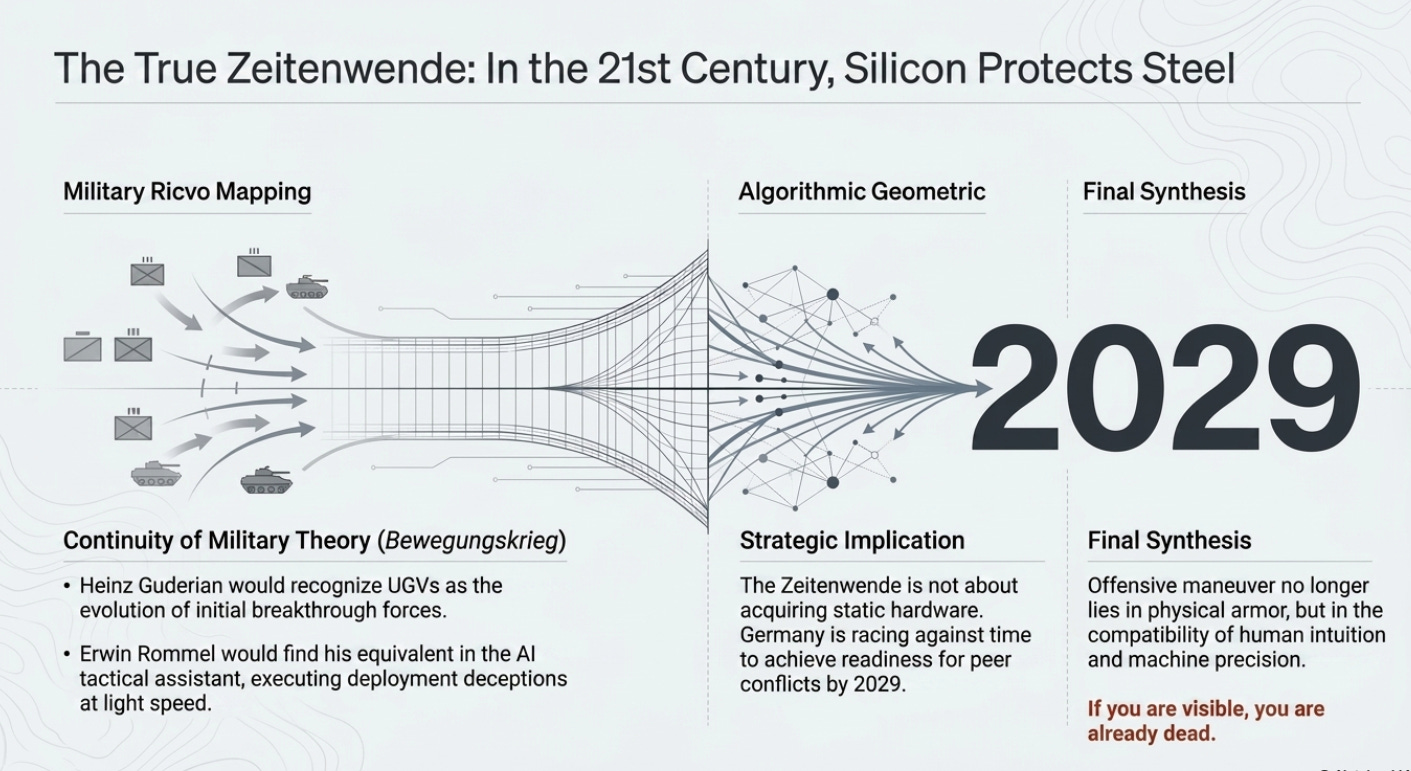
The restoration of the offensive maneuver depends less on buying more tanks and more on the “Digital Glue” of interoperability and AI-assisted decision-making. The Zeitenwende is a race against time; Germany and its allies are preparing for a peer-conflict scenario by 2029. Currently, the Heer is “digitally naked” compared to the Munster ideal, and the gap between this technological demonstration and frontline reality is the greatest strategic risk facing Europe. We must move beyond the static, 20th-century mentality that views mass as a physical quantity. In the transparent world of the 2020s, if you can be seen, you are already dead. The future belongs to the force that can operate in the gaps, using silicon to protect its steel. Final Synthesis: In the war of the 21st century, the compatibility of differences—the seamless integration of human intuition and machine precision—is the foundation of a lethal, resilient, and unpredictable force.
Conceptually impressive doctrine and thought process.
As well as the digital infrastructure, it also seems very dependent on hardware at mass; just of a different kind to the Tanks and IFVs of the late cold war - the FPV drones, UGVs, various short range air defences.